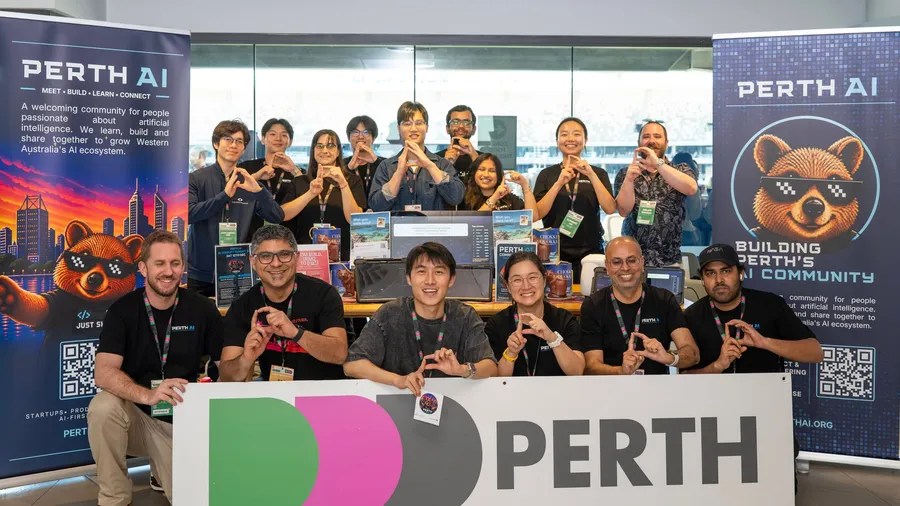
The short version: PerthAI had a stall at DDD Perth on Saturday 3 October, and I made the game for its touch screen. My first version was a trivia quiz and it felt boring, so I rebuilt it as Quokka Run, a one-tap runner where a quokka jumps over hallucinations and GPU fires and has to tell fact from hallucination at every gate. People got far more competitive about it than I expected, so it now lives on the PerthAI site, where you can play it.
What was the PerthAI stall at DDD Perth?
DDD Perth is Perth’s community-run developer conference. PerthAI, the volunteer-run community for people building with AI that I help organise, had a booth there this year.
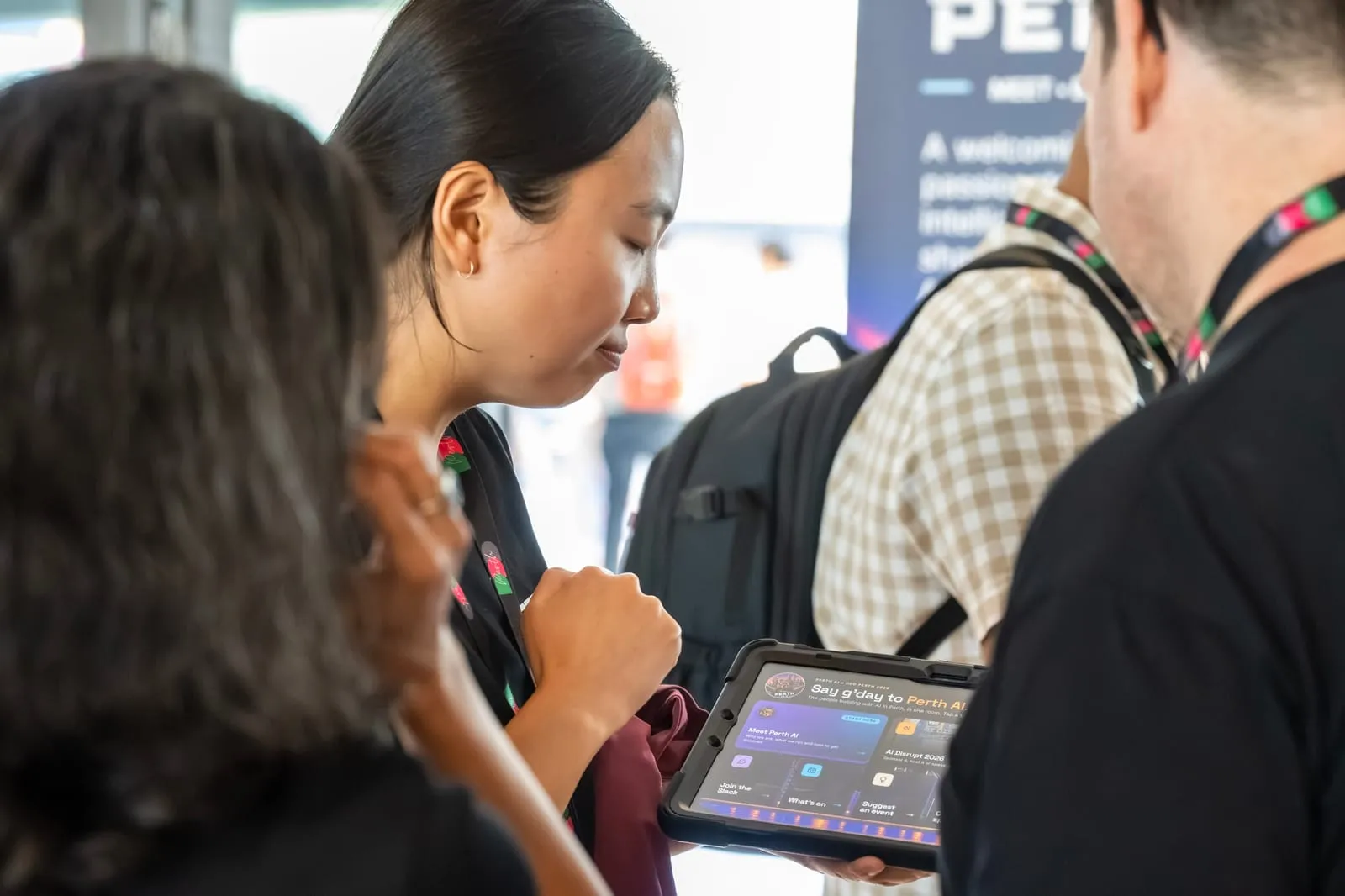
The booth had a big screen and tablets running a touch-screen app I built for the day. It introduced PerthAI, took sign-ups for our Slack and events, asked for venues, sponsors and speakers for AI Disrupt Summit 2026, and ran the game. Students could open the same app on their phones and play on the same leaderboard. One of the team also brought a Reachy Mini robot for people to meet.
There were prizes too. The top Quokka Run score of the day won a trip for two to Rottnest, a JB Hi-Fi voucher was drawn on the main stage, and a prize wheel on the booth screen gave away chocolate quokkas to people who had played.
Why build a game for a conference booth?
The brief was a kiosk screen with a trivia game on it.
The sign-up screens did the practical work: collecting contacts so we could tell people about our events. The game’s job was different. It was there to grab attention, to run a competition, and to make the stall feel fun and inviting, so people would wander over and start talking to us.
How did a trivia quiz become Quokka Run?
I built the first version, a quiz called “Fact or Hallucination?”, on 25 September. It showed AI-themed statements, asked whether each was true or made up, and kept a leaderboard. It worked, but it felt boring.
So I took inspiration from the Chrome Dino runner, the game that appears when your browser has no internet connection. By that afternoon there was a running quokka, and the quiz statements had become gates on the road. A few hours later I deleted the quiz altogether, because the game already asked the same questions.
My daughters helped me come up with the idea, and we built it together using Claude Code.
How do you play Quokka Run?
It is a one-button game. Tap, click or press a key to jump.
You jump over hallucinations, GPU fires and 429 signs (the HTTP error for too many requests, which anyone who uses AI APIs knows well). Some hallucinations fly, and you run under those instead.
Every so often a gate appears with a statement on it. Jump through it if you think the statement is a fact, or run under it if you think it’s a hallucination. Easy statements are worth 150 points, medium 250 and hard 400, and the game gets faster every 20 seconds.
The statements were the part that needed the most care. There were 139 of them at DDD, a mix of AI, developer culture and WA trivia. Topics that only had a true version got a made-up twin, so “fact” was never a safe guess. Every statement was fact-checked against a source, which is not something you want to skip in a game about hallucinations.
How did I build it?
Everything was built with Claude Code. The first version was a small app that ran on a laptop at the booth, with its own little database, and kept working without an internet connection.
The next day I moved it onto perthai.org, so the booth screen, the tablets and phones could all share one leaderboard. The game itself is plain JavaScript drawing to a canvas, and the scores went into a small database on Cloudflare, where the PerthAI site is hosted.
Most of the work in the following week went on things a booth needs and a normal website doesn’t:
- Wifi drop-outs. Scores and sign-ups are saved on the device first and sent when the connection comes back, so a drop never loses one.
- A busy booth. After a quiet minute the booth screen wipes back to the home screen, so the next visitor never sees someone else’s details. When nobody’s using it, the game plays itself.
- Fair levels. A bot played every level to check each one could actually be cleared.
- The prize draw. The wheel spins on every idle booth screen, but the server has already picked the winners at random. The wheel is just the show.
Other PerthAI volunteers reviewed the changes before they went live, and one sent in fixes for phones held in portrait.
If you’ve read about Agent Pinball, the pattern will be familiar: build a version, play it, notice what’s wrong, change it. This time it all happened in about a week, with a deadline at the end.
What happened on the day?
People got competitive. Many came back through the day to check whether their high score was still on top. PerthAI’s own wrap-up post called the game an “absolute crowd-pleaser”.
They also played for much longer than I’d planned for. The game stopped getting faster after two minutes, and some single runs went on for an hour. That was fine on the day, but it wouldn’t work for a public leaderboard.
The top score ended up somewhere around 50,000. We had a lot of players and a lot of sign-ups, though I don’t have exact numbers.
What did PerthAI get out of the day?
Exposure, mostly, and lots of conversations. A stall at a conference this size puts PerthAI in front of people who’ve never heard of us, and it gave us a chance to talk about why PerthAI exists: to give everyone in WA building with AI a place to learn in the open, meet the people doing it well, and ship better work because of it. PerthAI’s wrap-up thanked everyone for those conversations and for their feedback, including on our quokka mascot and logo.
Can I still play Quokka Run?
Yes. Since 10 October, Quokka Run has had its own page on perthai.org, with a public leaderboard. It keeps the name you choose and your score, and no email or phone number unless you enter the competition.
It also never stops getting faster now, so even a great run ends in a few minutes. Until 30 November, the top score saved with an email wins a ticket to AI Disrupt Summit 2026.
I posted about it on LinkedIn too. If you beat my score, or find a statement you think is wrong, let me know.
Photos from DDD Perth by Arlen Brower for PerthAI.